SHOP NOW & SAVE 10$ SITEWIDE – CODE RRJ10

Pack It Away: How to Safely Store Your Leather Jacket in the Off-Season

Written by RedRock Jackets Editorial Team Specialists in premium genuine leather jackets for men and women across the USA.
You finally found it – the jacket that fits like it was made for you. Maybe it’s a rugged biker jacket in full-grain cowhide, or a buttery-soft lambskin bomber that never fails to turn heads. Whatever it is, it was an investment. And like any worthwhile investment, it deserves to be taken care of.
The problem? Most people toss their leather jackets on a hook, stuff them into a corner of the closet, or worse – seal them in a plastic garment bag and forget about them until next fall. By the time cooler weather rolls back around, that once-beautiful jacket is stiff, cracked, or carrying the faint, musty smell of mildew.
At RedRock Jackets, we’ve been crafting and sourcing premium genuine leather jackets for men and women across the USA for years. We’ve seen the damage that poor storage does – and we’ve seen what a little extra care can do to keep a jacket looking like new for decades. This guide gives you everything you need to know about how to store a leather jacket the right way.
Why Proper Leather Jacket Storage Matters
Leather is a natural material. It breathes, it expands and contracts with temperature changes, and it holds moisture – which is exactly why it feels so comfortable to wear but also why it needs a bit more attention than your average nylon windbreaker.
When leather is stored incorrectly, a few things can go wrong:
Leather cracking is the most common issue. Without regular conditioning and in a dry, poorly-ventilated space, leather dries out and begins to split along natural stress lines – the elbows, collar, and underarms first.
Mold and mildew growth happens when leather is stored in a humid environment without airflow. The surface develops grey or green spots that are difficult to remove and can permanently stain or weaken the material.
Misshaping occurs when jackets are folded and stacked for extended periods or hung from thin wire hangers that cut into the shoulders, creating permanent creases and distorting the jacket’s silhouette.
Odor absorption is also a real issue. Leather is porous, and if it’s stored near cleaning chemicals, cardboard boxes, or damp walls, it picks up those smells fast.
The good news: all of this is entirely preventable with the right approach to leather jacket storage.
Step 1 – Clean Your Leather Jacket Before Storage
Never put a dirty jacket into storage. Any oils, sweat, salt residue, or surface grime left sitting on leather for months will break down the surface and create conditions where mold thrives.
Here’s how to clean a genuine leather jacket before storing it:
Surface wipe-down: Use a soft, damp cloth – not soaking wet, just lightly moistened – and wipe down the entire outer surface. Work gently in circular motions. Don’t scrub.
Lining care: Turn your attention to the interior lining. Spot clean with a slightly damp cloth and a tiny amount of mild soap if needed, then let it air dry completely before doing anything else.
Stain treatment: For stubborn stains, use a leather-specific cleaner. Avoid anything with alcohol, bleach, or acetone – these strip the natural oils from the leather and cause irreversible drying and discoloration.
Air it out: After cleaning, hang the jacket in a well-ventilated space indoors for at least 24 hours before moving on to the next step. Never store a jacket that has any residual moisture in it.
Step 2 – Condition the Leather
Conditioning is the single most important thing you can do for long-term leather jacket maintenance. Think of it the way you’d think of moisturizing your skin before a long, dry winter – the leather needs that protective barrier to stay supple through months of storage.
Apply a quality leather jacket conditioner with a soft cloth, working it in using gentle circular motions. Pay extra attention to areas that tend to dry out first: the collar, cuffs, elbows, and any area that folds or flexes during normal wear.
Let the conditioner absorb fully – typically 10 to 15 minutes – then buff off any excess with a clean, dry cloth.
RedRock Jackets‘ recommendation: Based on our experience working with lambskin, cowhide, and full-grain leather, we suggest conditioning your jacket at least once before storing it, and then again every 4 to 6 months during long-term storage. This helps reduce drying and maintain flexibility, especially for jackets stored through the seasonal extremes that many U.S. regions experience – from the dry heat of a Texas summer to the humidity of the Gulf Coast or the freezing winters of the Midwest.
Step 3 – Choose the Right Hanger
This step gets overlooked more than any other, and it causes more damage than most people realize.
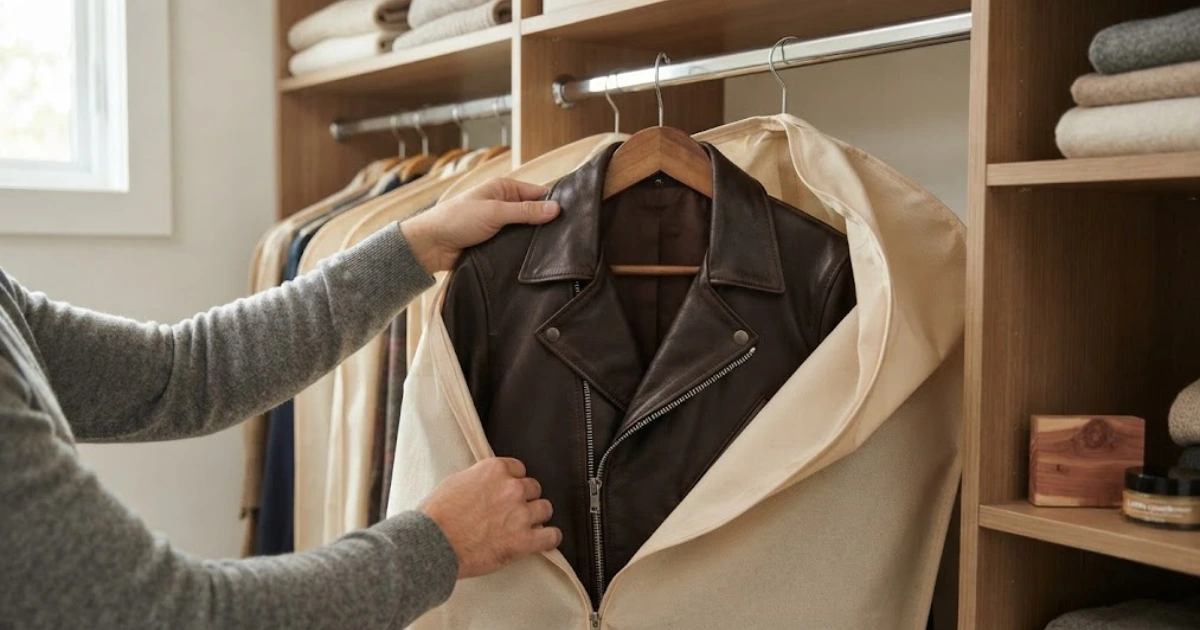
Always hang your leather jacket on a wide, padded hanger or a thick wooden hanger. The shoulder support matters enormously here. A thin wire hanger from the dry cleaner will dig into the shoulder seam, create a crease that’s almost impossible to reverse, and can actually distort the structure of the jacket over time.
Look for hangers that are:
- At least 17–18 inches wide to match the jacket’s shoulder span
- Made from solid wood (cedar hangers are ideal – more on that below) or padded fabric
- Rounded at the shoulders, not angular or sharp-edged
Cedar hangers are a particularly smart choice for leather jacket storage. Cedar is a natural insect repellent, helps regulate moisture in enclosed spaces, and imparts a subtle, clean scent that counters mustiness. If you’re investing in a quality hanger for a quality jacket, cedar is the way to go.
Step 4 – Use a Breathable Garment Bag
Once the jacket is on the right hanger, it needs dust protection – but it also needs to breathe.
The ideal solution is a breathable cotton garment bag. These allow air to circulate around the leather, preventing the buildup of moisture that leads to mold and mildew, while still protecting the surface from dust accumulation and accidental scratches.
Look for a bag that:
- Is made from 100% cotton or a similar natural, breathable fabric
- Is long enough to cover the full jacket without compressing the hem or cuffs
- Has a zipper or closure at the top that isn’t so tight it seals off all airflow
Breathable cotton bags are widely available online and at most luggage or storage retailers. For a premium leather jacket, the few dollars spent on a proper bag is absolutely worth it.
Step 5 – Avoid Plastic Covers at All Costs
If you take nothing else away from this guide, take this: never store a genuine leather jacket in a plastic bag or plastic dry-cleaning cover.
Plastic traps moisture against the leather surface and creates exactly the warm, humid, airless environment that mold and mildew love. Even if the jacket goes in dry, condensation can form inside the bag over time – especially with seasonal temperature changes. The result is a jacket that comes out of storage smelling musty, showing white bloom on the surface, or worse, spotted with mold that has already begun to break down the leather fibers.
This applies to:
- Dry-cleaning plastic covers
- Zip-lock bags
- Sealed plastic storage bins
- Vacuum storage bags (these compress the leather and destroy its shape)
Step 6 – Store in a Cool, Dry Place
Where you store your jacket matters just as much as how you prepare it.
The ideal storage environment for a genuine leather jacket is:
- Temperature: Between 50°F and 70°F (10°C–21°C). Avoid spaces that get very hot in summer or very cold in winter.
- Humidity: Between 40% and 50% relative humidity. Too dry causes cracking; too humid encourages mold.
- Ventilation: Airflow is essential. Never store leather in a sealed closet that gets no circulation.
- Light: Keep leather away from direct sunlight and UV exposure, which fades color and dries out the material rapidly.
Best storage spots:
- A bedroom closet with the door left slightly ajar
- A dedicated wardrobe with breathable panels
- A climate-controlled storage unit for long-term needs
Avoid:
- Attics (too hot in summer, temperature extremes year-round)
- Basements (too damp, prone to mold and mildew)
- Garages (humidity and temperature fluctuations, potential pest exposure)
- Spots near exterior walls in extreme climates
Leather Storage by U.S. Region – What You Need to Know
The United States spans dramatically different climates, and your storage strategy should reflect where you live.
Southeast and Gulf Coast (Florida, Louisiana, Mississippi, Georgia): High year-round humidity is your biggest threat. Invest in a good dehumidifier for your closet space or add silica gel packets near (not touching) the jacket to help manage moisture. Condition more frequently – every 3 months during storage is smart here.
Desert Southwest (Arizona, Nevada, New Mexico): The opposite problem – extreme dryness. Leather stored in these regions dries out faster. Condition thoroughly before storage and check the jacket mid-season to see if it needs a touch-up application.
Midwest and Great Plains (Illinois, Kansas, Nebraska, Minnesota): Wildly swinging temperatures between summer and winter stress the leather. A climate-controlled closet or storage unit is particularly valuable here.
Pacific Northwest (Oregon, Washington): Cool and damp conditions mean mold and mildew are real risks. Breathable storage and proper ventilation are essential.
Northeast (New York, Massachusetts, Pennsylvania): Four true seasons mean leather goes into storage for legitimate stretches. Condition well, use a proper garment bag, and check mid-storage.
Lambskin vs. Cowhide vs. Full-Grain – Does Storage Differ by Leather Type?
| Leather Type | Thickness & Weight | Storage Risk | Key Storage Requirement |
| Lambskin | Ultra-thin, lightweight, extremely soft. | Highly prone to tearing, deep creasing, and permanent hanger indentations. | Must use padded hangers. Never fold or crowd tightly against other garments, as the delicate skin absorbs pressure marks easily. |
| Cowhide | Thick, heavy, and naturally rigid. | Over time, its own heavy weight can distort the silhouette or stretch out the shoulders of a jacket if hung improperly. | Requires wide, heavy-duty wooden hangers to support the weight. Can tolerate standard wardrobe spacing better than lambskin. |
| Full-Grain | Variable thickness, but retains the highly porous natural top layer of the hide. | Highest risk for mold, mildew, and drying out. Because it is completely uncorrected, it absorbs ambient moisture and spills rapidly. | Breathability is vital. Never store in plastic bags; use breathable cotton garment bags and strictly maintain stable 40-50% humidity. |
Common Mistakes That Damage Leather Jackets in Storage
Even careful people make these errors. Here’s what to avoid:
Folding instead of hanging. Leather develops permanent crease lines when folded for extended periods. Always hang.
Hanging over a door hook. The single-point pressure from a door hook compresses the collar and distorts the shoulder. Use a proper hanger in a closet.
Skipping the conditioning step. Even if the jacket looks fine when you put it away, leather loses moisture during storage. Condition before and periodically during storage.
Storing near other materials that bleed dye. Dark fabrics stored directly against light leather can transfer color. Keep leather jackets separate.
Forgetting to check on it. A quick mid-season inspection – maybe once every 8 to 10 weeks – lets you catch any mold, dryness, or odor issues early before they become serious problems.
Using heat to dry a wet jacket. If your jacket gets wet before storage, never use a hair dryer, radiator, or direct heat to dry it. Let it air dry naturally, away from sunlight, then condition before storing.
How Often Should You Condition Leather?
A common question we get at RedRock Jackets – and a fair one.
Here’s a practical breakdown:
- Before storage: Always condition, regardless of when you last did it.
- During long-term storage (6+ months): Condition every 4–6 months.
- After taking it out of storage: Condition again and let it breathe before wearing.
- During active wear seasons: Condition every 3–6 months depending on how often you wear it and the climate you live in.
Signs your leather needs conditioning: the surface looks dull rather than having a subtle sheen, the leather feels stiff or makes slight cracking sounds when flexed, or you notice early surface cracking around flex points.
Storing a Leather Jacket During a Move or Relocation
Relocating is one of the highest-risk moments for leather jackets. Here’s how to protect yours:
Never put a leather jacket inside a moving box – the compression, stack weight, and temperature extremes in a moving truck can cause permanent damage.
Transport your leather jacket on a hanger inside a breathable garment bag, ideally hung in the back seat of your car or in a protected wardrobe box that keeps it vertical. If the move is long-distance, be mindful of the temperature inside your vehicle during transit and keep the jacket out of the trunk.
Storing Vintage Leather Jackets
Vintage jackets – especially those from the 1950s through 1980s – deserve even more careful treatment. The leather in older jackets is often more dried out to begin with, and the dyes and finishes are more susceptible to damage.
Before conditioning a vintage jacket, test any product on a small, inconspicuous area and wait 24 hours to check for color change or adverse reactions. Use a conditioner formulated for aged leather if available. And if the jacket has significant historical or monetary value, consider consulting a professional leather restoration specialist before attempting home storage care.
Frequently Asked Questions
Can leather jackets be stored in plastic bags?
No. Plastic traps moisture and prevents the leather from breathing, creating conditions that encourage mold, mildew, and surface bloom. Always use a breathable cotton garment bag instead.
How long can a leather jacket stay in storage?
A well-prepared genuine leather jacket can stay in storage for an entire season – typically 5 to 7 months – without issue. For storage beyond that, do a mid-storage conditioning treatment and inspect for any signs of dryness or mold.
Should I use leather conditioner before storing?
Absolutely. Conditioning before storage is one of the most important steps. It replenishes the natural oils in the leather and creates a protective barrier that reduces drying during the months it sits unused.
What’s the best hanger for a leather jacket?
A wide, padded hanger or a solid cedar hanger at least 17–18 inches wide. The width supports the jacket’s shoulder structure and prevents the creasing and distortion caused by thin wire hangers.
Can leather jackets develop mold in storage?
Yes, and it happens more easily than most people expect – especially in humid climates like the Southeast and Pacific Northwest. Proper cleaning before storage, breathable storage bags, and a cool, ventilated space will dramatically reduce this risk.
How do I prevent leather cracking?
Regular conditioning is the single most effective prevention. Leather cracks when it loses its natural moisture and oils. A quality conditioner replaces those oils and keeps the material supple and flexible.
Is a garment bag necessary?
It’s strongly recommended for any jacket going into off-season storage. Without one, dust settles into the leather’s natural grain, other items in the closet can brush against and scratch the surface, and light exposure (even indirect) can gradually fade the color.
Should I store leather jackets in the attic?
No. Attics experience extreme temperature swings – often well above 100°F in summer – and fluctuating humidity levels that are harmful to leather. A climate-controlled interior closet is always a better option.
Shop Premium Leather Jackets at RedRock Jackets
A great leather jacket, properly cared for, is a piece you’ll wear for decades. It breaks in, develops character, and fits better with every season.
At RedRock Jackets, every jacket in our collection is crafted from premium genuine leather – including lambskin, cowhide, and full-grain leather – and shipped directly to your door across the USA.
Whether you’re shopping for yourself or looking for a gift that will last a lifetime, explore our full range:
- Men’s Leather Jackets – Classic and modern cuts in genuine leather
- Women’s Leather Jackets – From fitted riders to oversized bombers
- Biker Jackets – Built for attitude, made to last
- Bomber Jackets – Timeless style in premium materials
- Cafe Racer Jackets – Streamlined, minimal, and sharp
- Leather Coats – Full-length coverage for colder months
Free shipping available across the USA. Real leather. Built to last.
Have questions about leather care or need help finding the right jacket? Contact our team – we’re happy to help.
RedRock Jackets | Premium Genuine Leather Jackets for Men & Women | Made for the USA
One thought on “Pack It Away: How to Safely Store Your Leather Jacket in the Off-Season”